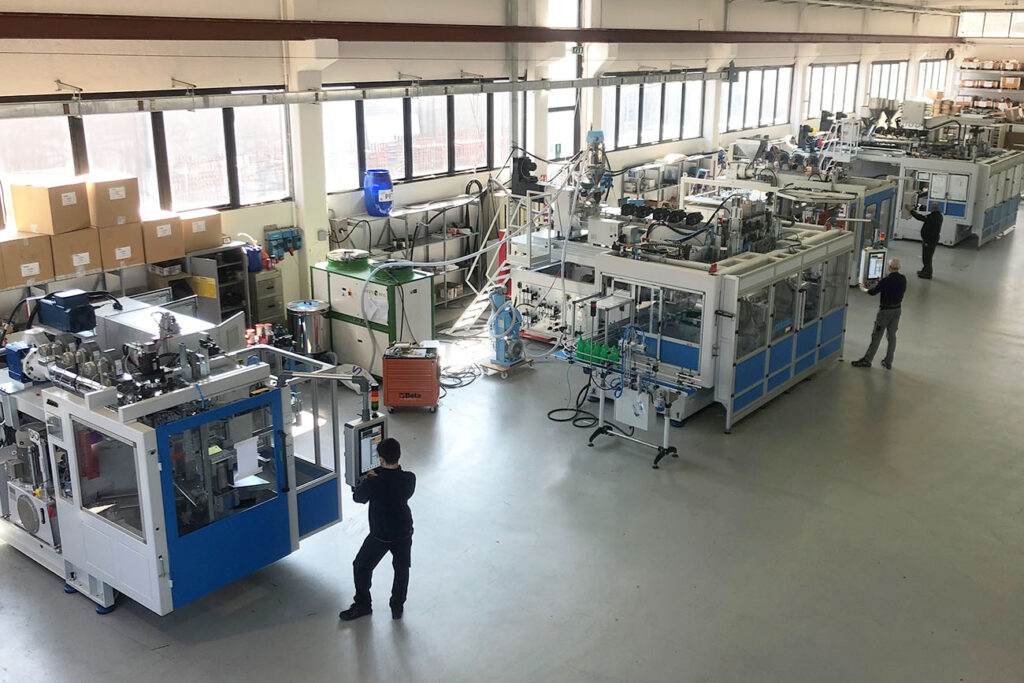
The background noise is typical of industrial plants: extruders working non-stop, molds opening and closing, arms moving with precision as canisters, bottles, and tanks take shape. In the midst of this steel choreography is a name that has been returning for over fifty years: Automa, today in the form of Automa by Magic, specialized in extrusion blow molding machines.
Behind it lies a brand born in 1972, with thousands of machines installed worldwide. More than 3,500 systems tell a long industrial story made of containers, technical items, and components that have crossed decades and markets. Ahead, however, is a reality that has chosen to restart with a new perspective, featuring electric machines designed and tested in Italy.
Isn’t it curious that such a historic brand presents itself today as one of the most interesting laboratories for the renewal of machinery fleets?
From the origins to the new course: the birth of Automa by Magic
Automa by Magic took shape in 2018, from the joint will of an established manufacturer in the blow molding world and other industry professionals. The goal is clear: not to let a brand fade away that, in over forty years, built a solid reputation with customers, keeping alive a technical heritage made of know-how, designs, and proven solutions.
In the early years of the new course, dozens of new-generation hydraulic machines were introduced to the market, both continuous extrusion and accumulation head types. These systems maintain Automa’s historic construction layout but are updated in every sensitive part: components, technical solutions, and electronic management.
The leap in quality then comes with the introduction of fully electric machines. It is here that the brand makes a sharp break from the past, focusing on energy efficiency, movement precision, and a reduction in oil use in line with new environmental and safety sensitivities.
Extrusion blow molding machines: an evolved range
Today, the offer revolves around two major families of systems: Extrusion Blow Molding and Accumulation Head Extrusion Blow Molding. Both are dedicated to molding, the technology that transforms a tube of molten plastic material into a hollow body: a canister, bottle, tank, or duct.
Electric continuous extrusion machines represent the future of the company: robust, designed for repetitive production of bottles and containers of various capacities. Alongside these, accumulation solutions allow for managing larger parisons, essential for complex technical items or large-volume tanks.
To this foundation, the most recent chapter has been added: the full electric series, where the AbM line stands out, described internally as the “new frontier.” Here, the following come into play:
- carriage closures driven by brushless motors,
- movement management without traditional hydraulics,
- more stable cycles,
- controlled consumption and lower maintenance requirements.
Behind the acronyms, ultimately, is the idea of combining years of accumulated experience with the opportunities offered by electric technology: the same process logic, but with more precise and flexible tools.
Markets served: from automotive to detergents, passing through food
Looking at the types of items these machines are designed for, a rather vast map emerges. The heart remains industrial and technical packaging, but applications touch different worlds.
In the automotive, lubricants, and technical items sector, the systems produce:
- canisters and bottles with or without handles,
- containers with a view stripe,
- items using recycled material,
- technical components where thickness control is decisive.
In the food and beverage sector, the focus shifts to containers that must comply with strict safety and hygiene standards. Here, certified materials, tight tolerances, and controlled processes come into play, because a defect is not just an aesthetic problem: it can directly affect the quality of the packaged product.
Then there is the large chemicals and canisters chapter, with vessels designed to contain gasoline, solvents, and industrial detergents. In this field, words like mechanical resistance, chemical compatibility, and transport sturdiness are not details, but minimum requirements.
Finally, the world of personal hygiene, cleaning, and medical, where bottles must integrate with high-automation lines, clean rooms, and sensitive filling systems. Attention to the container becomes an extension of the attention to the final consumer.
Implicitly, a common element can be seen: the ability to adapt the machine to the product and not vice versa, with solutions built on the specific needs of the producer.
Made in Italy: quality, design, and customization as a work method
One of the strongest identity traits is the choice to keep design, construction, and testing entirely in Italy. Not just as a label, but as a way to keep expertise, suppliers, and controls close at hand.
The industrial philosophy is based on several cornerstones:
- use of brand-name components to extend the machine’s life over time;
- careful selection and testing of technical materials, from the frame to the hydraulic and electrical parts;
- attention to customization, because every customer arrives with a different combination of products, rhythms, and factory layouts.
Behind the words “high-quality customization” is a simple idea: every system is a project in itself, requiring non-standardized engineering and construction attention. It is no coincidence that this capability is claimed as part of the company’s DNA.
On the design front, the reference is less about aesthetics and more about functionality. The machines are described as tools intended to work 24 hours a day, with an interface that must be intuitive for operators. Form, in other words, follows production needs: access spaces, material paths, mold housing—everything is modeled on the requests of those who will manage the plant in their daily routine.
Software, interface, and tele-service: the digital side of blow molding
If the body of the machines is mechanical, the mind is all in the software. Automa by Magic emphasizes having developed its own control system, designed to offer a clear user experience on a generous high-definition display.
The choice of a more readable and “user-friendly” interface is not just a whim: it means putting operators and maintenance technicians in a position to:
- read parameters even in contexts that are not ideally lit,
- intervene with fewer steps,
- reduce the risk of errors in adjustments.
An important chapter is remote connection. The machines are designed to be tele-assisted: engineers can access the system, update software, verify anomalies, and propose optimizations without being physically present in the factory. It is a valuable lever in a historical moment where downtime and travel difficulties have become sensitive issues.
And what if they told you that, today, a part of maintenance is played out more on a technician’s screen than on a workbench?
Services and mission: much more than a machine builder
Alongside the production side, Automa by Magic insists heavily on the service dimension. It does not only handle systems of its own construction but also follows:
- overhauls and refurbishments of machines from other brands,
- retrofitting to adapt existing systems to new products,
- PLC system updates on various platforms,
- constant support with a dedicated customer service.
The internal mission is described as being centered on listening: truly putting the customer at the center, interpreting their needs, and giving rapid and professional answers. A formula that translates into three very concrete operational pillars:
- assistance, with process experts who try to anticipate needs before they turn into problems;
- scheduled maintenance, to preserve productivity and reliability over time;
- delivery and after-sales management, treating every machine not as a “sold piece,” but as a project that continues to live in production.
A historic brand in a new phase
Putting all these elements together—the long history started in 1972, the restart in 2018, the evolution toward electric machines, the choice to keep the center of gravity in Italy, the focus on software and tele-service—the image emerges of a brand playing for its second life.
On one hand, there is continuity with the past: more than 50 years of presence in the blow molding world, thousands of systems delivered, and consolidated relationships in various sectors. On the other, there is a clear push to respond to the industry’s new demands: energy efficiency, sustainability, digitalization, and flexibility.
Did you know that behind a canister or bottle you pick up every day there could be the silent work of a machine designed to run non-stop, connected to a technician observing it from a distance, updated with new software while production continues?
In the middle, between steel and code, is the space that Automa by Magic has chosen to occupy: guarding a historic blow molding heritage and, at the same time, rewriting it in light of today’s technologies and sensibilities.